How to Pick a CRM: A 12-Point Checklist
A practical 12-point checklist for picking a CRM that fits your business. Use it to cut through vendor marketing and make a confident decision.
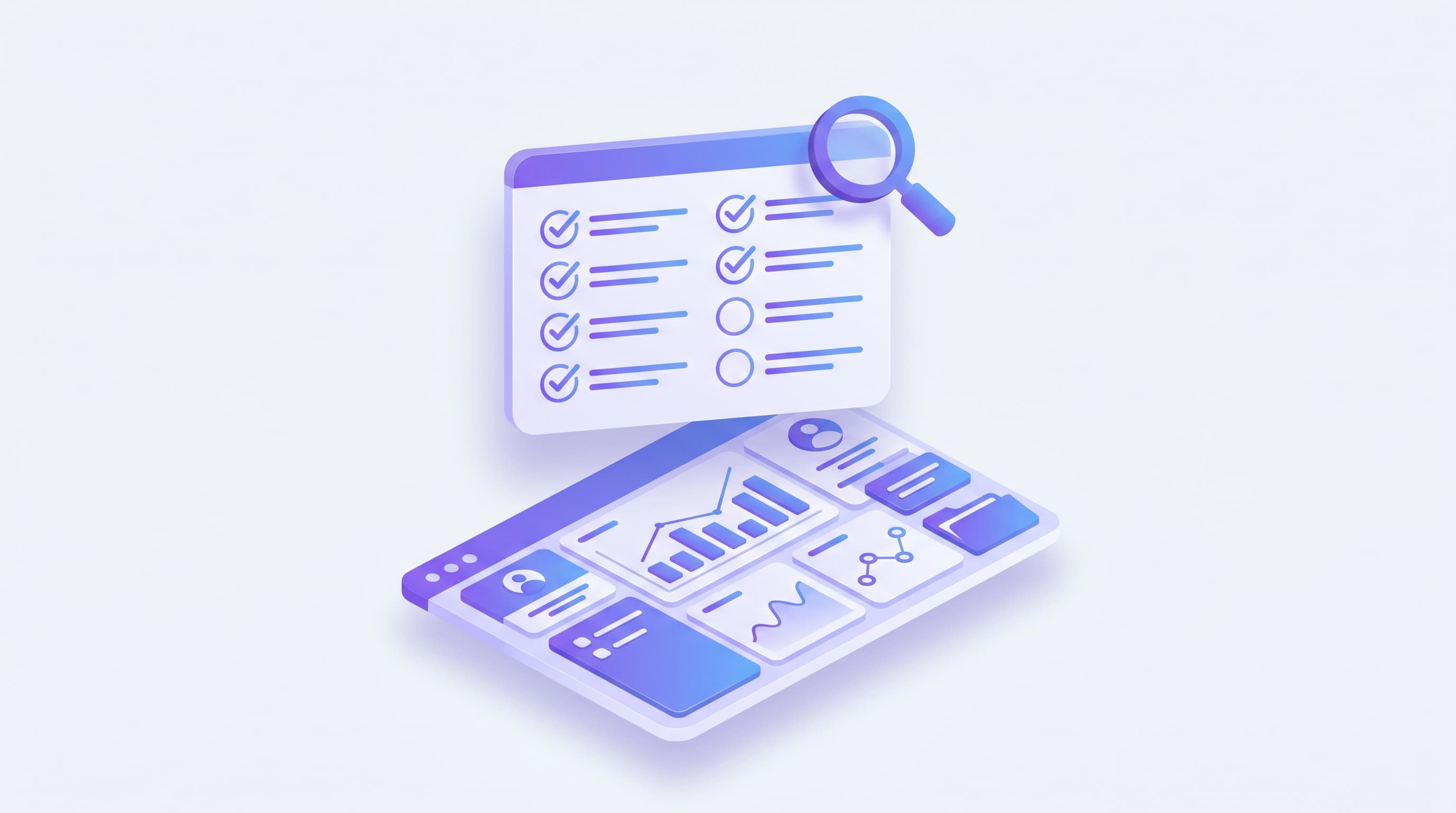
How to use this checklist
There are roughly 600 CRMs on the market in 2026. Vendor websites all promise the same things — "increase revenue, save time, delight customers" — and feature lists run to 100+ items. Cutting through that takes a structured shortlist.
This 12-point checklist scores any CRM against what actually matters for a small business. Apply it to your top 3 candidates, total the scores, and pick the winner. The whole exercise takes about 4 hours of focused work spread over two weeks.
For broader context on which CRMs to consider in the first place, see CRM for small business: the 2026 buyer's guide.
1. Pipeline flexibility
Can you customize the pipeline stages without paying extra or calling support? Can you have multiple pipelines for different products or services? Can you drag-and-drop deals between stages?
This is the screen your team will live in. If it's awkward, nothing else matters.
Test: Create a pipeline with 5 custom stages. Drag a deal through them. Set up a second pipeline for a different product line.
2. Contact + company data model
Does the CRM separate people (contacts) from organizations (companies)? Can multiple contacts attach to one company? Can a contact have multiple deals?
This sounds like plumbing but it determines whether your data stays clean as you grow. CRMs without proper contact-company relationships create duplicates within months.
Test: Add a contact, attach them to a company, attach 2 deals to the contact. Check whether the company view shows both deals.
3. Email + SMS in the CRM
Sending email and SMS from the CRM (and seeing replies show up there) is what separates a CRM from a database. Bonus: bulk messaging with merge tags and replies threading back to the right contact.
Test: Send an email to yourself from the CRM. Reply to it. Verify the reply shows up on the contact's timeline.
4. Activity log + timeline
Every call, email, SMS, meeting, and note should appear in chronological order on the contact and on the deal. No exceptions.
Test: Make a call, send an email, log a note, schedule a meeting — all on the same contact. Open the contact view. All four should be visible in one timeline.
5. Mobile experience
Owners and reps work from phones. The CRM's mobile experience must do at least: pipeline view, contact lookup, click-to-call, send SMS, log a note, take a photo and attach it. A responsive web app on a phone browser is fine — what matters is that it's usable, not whether it ships in an app store.
Test: Open the CRM on your phone (browser is fine). Try to do a full deal update from that view. If you can't, you'll find your team falling back to text messages and forgetting to log anything.
6. Data import + export
Can you import contacts from CSV without a vendor migration team? Can you export your full data — contacts, deals, activity, notes — in standard formats (CSV, JSON)?
If export is locked behind a Pro plan, you're being prepared for vendor lock-in. Walk away.
Test: Import a 100-row CSV. Then export it. Verify all fields round-tripped correctly.
7. Integrations that matter
Not "they have 1,500 integrations." The real question: do they natively integrate with the 5 tools you actually use? Common list for a small business:
- Email provider (Gmail / Outlook)
- Calendar (Google / Outlook / Apple)
- Payments (Stripe / Square / QuickBooks)
- Phone / VoIP (Twilio / native)
- Accounting (QuickBooks / Xero)
If any of those is missing, that's an extra app in your stack and friction in every workflow.
Test: Connect your real Gmail and calendar. Send an email; verify it logs. Book a meeting; verify it syncs.
8. Automations
Trigger-based workflows: "when a deal moves to Quoted, send the quote PDF and start a 3-step follow-up sequence." Without automations, your team is the trigger — which doesn't scale.
Most CRMs gate automations behind a higher tier. Verify the entry-tier price includes the automation features you need.
Test: Build one automation. Trigger it. Verify each step ran.
9. AI features (with depth, not gloss)
Every CRM in 2026 advertises AI. Some have one feature; some are AI-native. The four that actually matter for a small business:
- AI voice agent (answers calls, qualifies leads)
- AI copy assist (drafts emails, SMS)
- Predictive lead scoring (flags hot leads automatically)
- AI meeting summaries (call transcripts → notes)
Ask: which AI features are included on the plan I'd buy, and what do they cost extra?
Test: Ask the vendor for a live AI voice agent demo (not pre-recorded). If they refuse, that's your answer.
10. Pricing transparency
Every cost should be on the public pricing page. Per-user, per-month. Phone fees, SMS overages, voice agent minutes, setup fees, training fees. If pricing is hidden behind "talk to sales," small businesses end up paying retail while bigger ones negotiate.
Test: Try to calculate the total annual cost for your team size from the public pricing page alone. If you can't, that's a red flag.
11. Trial length and quality
A real trial is at least 14 days, with full feature access, using your actual data. Not a sandbox with demo data. Not a 7-day trial that ends before you've finished setup.
The trial is also the best predictor of vendor support quality. If support is slow during a trial, it'll be slow when you're paying.
Test: Sign up for the trial. Ask a real support question. Time the response.
12. Total cost of ownership
The number on the pricing page is rarely the total cost. Account for:
- Per-user fee × number of users × 12 months
- Add-on costs for AI, automations, premium support, etc.
- Telephony / SMS overage if you exceed bundled limits
- Migration / training time (your team's hours × hourly rate)
- Tools you can drop because the new CRM replaces them (savings)
Net it out. The CRM that looks 30% more expensive on per-user price often comes out cheaper after factoring in tools it replaces.
How to score your shortlist
Three CRMs. Twelve criteria. Score each on a 1–5 scale. Total each CRM. Highest total wins.
| Criterion | CRM A | CRM B | CRM C |
|---|---|---|---|
| 1. Pipeline flexibility | |||
| 2. Contact data model | |||
| 3. Email + SMS | |||
| 4. Activity log | |||
| 5. Mobile experience | |||
| 6. Data import/export | |||
| 7. Integrations | |||
| 8. Automations | |||
| 9. AI features | |||
| 10. Pricing transparency | |||
| 11. Trial quality | |||
| 12. TCO | |||
| Total |
Caveats:
- A score of 5 on TCO doesn't outweigh a score of 1 on pipeline flexibility. Weight criteria 1–5 (the day-to-day usability ones) higher if there's a tie.
- A live demo is worth more than a feature comparison sheet. Always trial, never buy on demo.
- Trust your team's reaction. If your sales lead opens CRM A and immediately starts using it without help, while CRM B requires a 2-hour training call, that's the answer.
Common mistakes when picking a CRM
Picking on AI buzzwords. "We use AI" appears on every vendor site. Until you've tested the actual AI capabilities, treat it as marketing. Live demos only.
Underestimating the migration. Importing contacts is easy. Importing 5 years of activity history with original timestamps and ownership is hard. Plan for it.
Overestimating future needs. "We might need this feature in 3 years" → wait 3 years. Pick the CRM that wins for now, plus the next 18 months. Switching costs in 3 years are real but lower than over-buying today.
Letting one stakeholder pick alone. The owner's preference matters, but the people using it daily matter more. If the front-desk person hates it, adoption fails.
Ignoring exit costs. Always ask: "How do I get my data out?" If the answer is unclear or "you'd have to call support," walk.
For pricing depth across the major options, see How much does a CRM cost in 2026 and the comparison section of CRM for small business.
A 2-week pick process
Week 1 — Shortlist
- Day 1: Define the 3 must-have features for your business
- Day 2: List 5 candidates from G2, Capterra, and word-of-mouth
- Day 3–4: Sign up for free trials of the top 3
- Day 5–7: Import 50–100 real contacts in each
Week 2 — Decide
- Day 8–10: Configure one pipeline and one automation in each
- Day 11: Have one teammate try each cold for 30 minutes
- Day 12: Score against the 12-point checklist
- Day 13: Sleep on it
- Day 14: Pick. Sign up. Start migrating.
Two weeks is enough. If you're still evaluating after a month, you're stalling. The cost of running with the slightly-wrong CRM is far lower than the cost of staying on a spreadsheet for another quarter.
The bottom line
There is no perfect CRM. There's a best-fit CRM for your business size, industry, and team. If you're in home services, real estate, legal services, healthcare, or professional services, industry-specific bundles often beat generic CRMs on day-1 usability — they ship with the right pipeline stages, the right fields, and the right integrations out of the box. The 12-point checklist gives you a structured way to find that fit without burning weeks on demos and feature comparisons.
The most common regret after picking a CRM isn't "we picked wrong." It's "we waited too long to pick anything." Run the process. Make the call.
Want to skip the checklist for one of the three? Try Easyly free for 14 days — score it against everything above and see how it stacks up.
Frequently asked questions
What are the most important CRM features to check for?
How long should evaluating a CRM take?
Should I pick a CRM based on price?
How many CRMs should I shortlist?
About the author
Easyly Team
The Easyly Team writes about AI, CRM, and running a small service business.