Email Marketing for Small Business: A Practical 2026 Guide
Email marketing for small business, explained: why it's the highest-ROI channel for lean teams, what to send, how to start, and how AI makes it easier.
What is email marketing for small business?
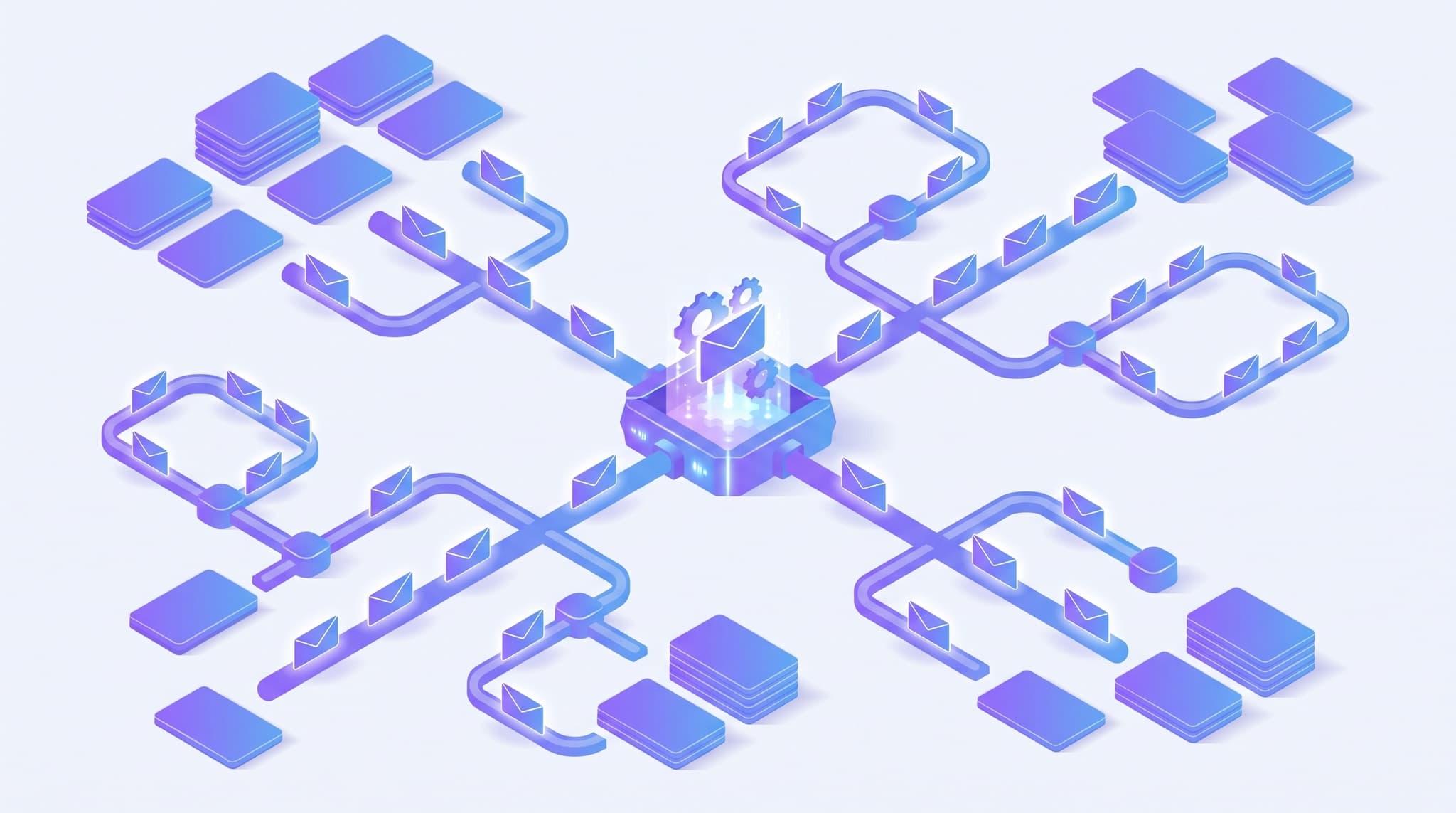
Email marketing for small business is the practice of sending targeted, permission-based emails — newsletters, promotions, and automated follow-ups — to customers and leads who opted in. For a lean team it's the highest-return marketing channel available: cheap to run, fully owned by you, and automatable, so every contact hears from you without manual effort.
That ownership is what sets it apart. Social followers and ad audiences are rented — an algorithm change or a rising cost-per-click can cut you off overnight. An email list is an asset you control. Combined with the fact that people still check email every day, that makes email the backbone channel most small businesses should build first, sitting right alongside the rest of their CRM for small business setup.
Why email marketing still works for small businesses
The case for email comes down to reach, economics, and control. Despite a decade of predictions that it would fade, email keeps growing. The number of email users worldwide topped 4.4 billion in 2024 and is projected to reach nearly 5 billion by 2028, according to The Radicati Group's Email Statistics Report, 2024–2028. Nearly everyone your business wants to reach has an inbox and checks it daily.
The economics are just as compelling. Email returns more per dollar than any other channel: Litmus's State of Email (2020) measured roughly $36 in revenue for every $1 spent — a figure that still anchors industry benchmarks years later. For a small business watching every dollar, a channel with that kind of return and near-zero per-message cost is rare.
For a small team specifically, three properties make email especially valuable:
- You own the audience. Your list can't be throttled by a platform the way reach on social can. Email it as often as you earn the right to.
- It's cheap and scalable. Sending to 50 people or 5,000 costs roughly the same effort, and most tools are free until your list grows.
- It automates cleanly. A welcome, a follow-up, a reminder — these run on their own once set up, which is where the real leverage is for a busy team.
Email marketing vs. other channels for small business
Email isn't the only channel, and the smartest small businesses use several. But each plays a different role, and knowing which to reach for keeps you from wasting effort — or annoying your audience.
| Email marketing | SMS marketing | Social media | Paid ads | |
|---|---|---|---|---|
| You own the audience | Yes | Yes | No | No |
| Cost per contact | Very low | Higher (per message) | Low (but time-heavy) | High (per click) |
| Best for | Nurturing, newsletters, offers | Urgent, time-sensitive messages | Awareness, community | Reaching new audiences fast |
| Speed to be seen | Hours | Minutes | Variable | Immediate (while you pay) |
| Ongoing cost | Flat/low | Per message | Time | Continuous spend |
The rule of thumb: email is for depth, SMS is for urgency, social is for discovery, and ads are for reach you don't have yet. Use email to nurture and tell your story over weeks; reach for SMS marketing when a message genuinely can't wait until the inbox gets checked. Most small businesses get the furthest by pairing a steady email program with occasional, high-intent texts — both working off the same contact record.
What to send: types of small business email campaigns
"Email marketing" isn't one thing. It's a handful of distinct email types, each doing a different job. The businesses that win send a healthy mix rather than only firing off discounts.
| Email type | What it is | Why it works |
|---|---|---|
| Welcome email | The first message a new subscriber gets | Engagement is highest right after sign-up — set expectations and make a first impression |
| Newsletter | Regular, useful content on a cadence | Keeps you top-of-mind and builds trust without always selling |
| Promotional | Offers, launches, seasonal deals | Drives direct revenue; works best when it's not the only thing you send |
| Automated follow-up | Triggered sequence after an action | Captures leads that would otherwise go cold — the highest-leverage automation |
| Transactional | Receipts, confirmations, reminders | Near-100% open rates; a quiet chance to reinforce the relationship |
| Re-engagement | Win-back for contacts gone quiet | Revives dormant leads far cheaper than finding new ones |
The strongest programs lean on automation for the repetitive, always-on emails — the welcome, the follow-up, the reminder — and reserve hands-on effort for the newsletter and the occasional campaign. If most of this sounds like plumbing rather than creativity, that's the point: the mechanics of triggered sequences are covered in our guides to lead nurturing and marketing automation for small business.
How to start email marketing for your small business
You can send your first real campaign within a week. Here's the practical order of operations — skip the temptation to overbuild before you've sent anything.
1. Pick email marketing software
Don't send marketing emails from your personal inbox — you'll have no opt-out handling, poor deliverability, and no way to measure results. Choose a tool that manages your list, handles unsubscribes automatically, and ideally keeps your emails in the same place as your contacts and calls. When email lives inside your Easyly CRM, a contact's full history — emails, texts, bookings — sits in one record instead of scattered across apps.
2. Build an opted-in list the honest way
Grow your list with genuine opt-ins: a sign-up form on your site, a checkbox at checkout, a lead magnet worth trading an email for. A smaller list of people who actually asked to hear from you will always outperform a big list of addresses you scraped or bought — both for results and for deliverability.
3. Segment so messages stay relevant
Even simple segments help: new leads versus existing customers, or by the service someone bought. A relevant email to the right group beats blasting everyone the same thing. Your CRM's contact data is what makes this easy, and it's the single biggest lever on performance (more on that below).
4. Write like a human and lead with value
Use a clear subject line, get to the point, write to one person rather than a crowd, and include one obvious next step. The fastest way to grow your unsubscribe rate is to send emails that are all about you. Every send should be something the reader is glad arrived.
5. Automate the essentials, then measure
Turn on a welcome email and one short follow-up sequence before anything fancy — these recover the revenue that leaks out of "I'll follow up later," and pairing them with a fast lead response time compounds the effect. Then watch three numbers: open rate, click rate, and unsubscribe rate. Let those signals, not guesswork, shape what you send next.
How AI makes small-business email marketing easier
The hard parts of email marketing — writing enough of it, and making each one feel personal — are exactly what AI now handles well. That matters because personalization is no longer a nice-to-have.
Relevance is measurable. A classic Mailchimp segmentation study found that segmented email campaigns earned 14.31% more opens and 100.95% more clicks than non-segmented sends — roughly double the clicks simply for sending the right message to the right group. And customer expectations have caught up: McKinsey's Next in Personalization report (2021) found that 71% of consumers expect personalized interactions and 76% get frustrated when they don't get them, with companies that excel at personalization generating about 40% more revenue from it.
For a two-person shop, hitting that bar by hand is impossible — and that's where AI earns its place:
- Drafting. AI writes first-draft subject lines, body copy, and variations in seconds, so a blank page never stalls your next send.
- Personalization at scale. It tailors content to each segment or contact using your CRM data, so "personalized" doesn't mean manually writing a hundred versions.
- Send-time and subject optimization. It learns when each contact tends to open and which lines land, then adjusts automatically.
- Triggered sequences. Paired with your pipeline, AI can decide what goes out next based on what a contact just did — a reply, a click, a booking.
The goal isn't to remove the human voice; it's to let one person run the email program of a much bigger team. Easyly's AI-powered marketing tools are built around exactly this — composing and automating personalized campaigns from the same place your contacts already live, so relevance doesn't cost you your evenings.
Common email marketing mistakes small businesses make
Buying or scraping a list. Emailing people who never opted in wrecks deliverability and trust, and in many places it's illegal. Earn every address.
Only ever selling. A list that hears from you only when you want money tunes out fast. Mix genuinely useful content between the offers.
Inconsistency. The business that emails sporadically — three sends one month, silence for three — trains its list to forget it. A sustainable rhythm beats occasional bursts every time.
Ignoring mobile. Most emails are opened on a phone. If yours needs pinch-and-zoom, it's deleted. Keep layouts simple and single-column.
Treating email as a silo. The biggest mistake is running email in a tool that doesn't know who your customers are. When email is disconnected from your CRM, you lose the behavior that makes messages relevant and you double your data entry. Evaluate the true cost the way you would any system, using our guide to how much a CRM costs.
The bottom line
Email marketing for small business endures for a simple reason: it's the one channel where you own the audience, the cost is near zero, and the return — around $36 for every $1 — beats everything else. For a lean team, that combination is hard to argue with.
The winners treat it as a system, not a series of one-off blasts. They build an opted-in list, send a consistent mix of useful content and clear offers, automate the welcome and the follow-up, and let AI handle the volume and personalization that a small team can't do by hand. Wire that into the same CRM for small business that already holds your contacts and conversations, and email stops being another chore — it becomes the most reliable, lowest-cost way you have to turn leads into customers and customers into regulars.
Frequently asked questions
What is email marketing for a small business?
Is email marketing still effective in 2026?
How much does email marketing cost for a small business?
How often should a small business send marketing emails?
What is the difference between email marketing and a CRM?
About the author
Easyly Team
The Easyly Team writes about AI, CRM, and running a small service business.