Lead Generation for Small Business: A Practical 2026 Guide
Lead generation for small business means turning strangers into interested contacts. Here are the channels that actually work, a simple system to run them, and the mistakes to avoid.
What is lead generation for small business?
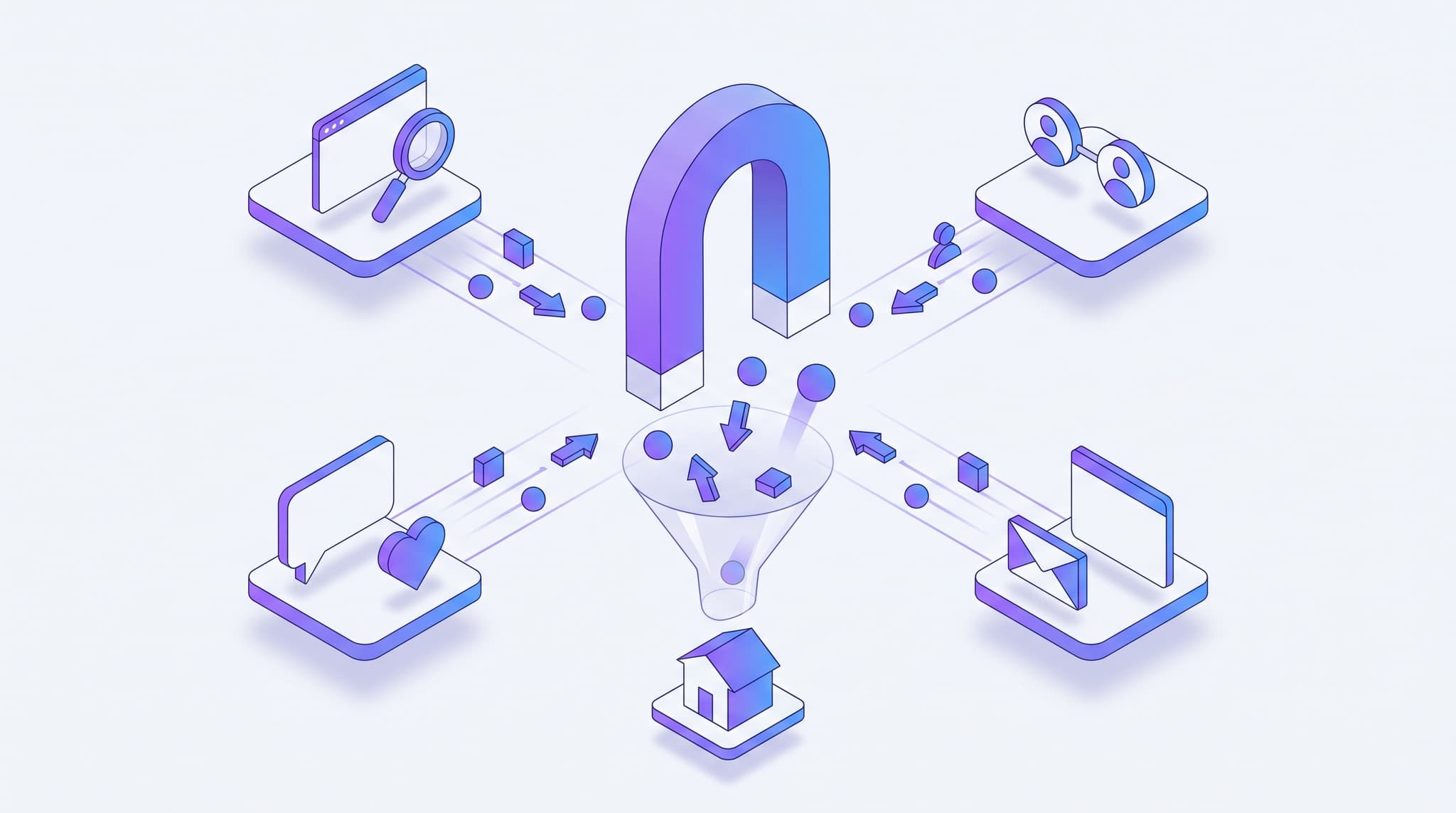
Lead generation for small business is the work of attracting strangers and turning them into people who have shared their contact details and want to hear from you. For a small team, it means picking two or three channels — referrals, local search, content, or outreach — and running them consistently instead of chasing every tactic at once.
The hard part is rarely knowing the tactics. It is building a repeatable system a busy owner can actually keep running, and making sure no lead falls through the cracks once it arrives. This guide covers the channels that work for small businesses, a simple system to run them, what leads should cost, and the mistakes that quietly waste the budget you do spend. It is a companion to our complete lead management guide, which covers what happens after a lead comes in.
The lead generation channels that actually work for small businesses
You do not need to be everywhere. Most small businesses get the majority of their leads from two or three channels and waste effort spreading thin across the rest. Here is how the main options compare for a small team with limited time and budget.
| Channel | Upfront cost | Time to first leads | Ongoing effort | Best for |
|---|---|---|---|---|
| Referrals & word-of-mouth | Very low | Immediate | Low (ask consistently) | Every service business |
| Google Business Profile & local SEO | Low | Weeks | Low–medium | Local & home services |
| Content & organic search | Low–medium | Months | Medium–high | Considered, researched purchases |
| Paid search & social ads | Medium–high | Days | Medium (needs monitoring) | Fast pipeline, testing offers |
| Social media (organic) | Low | Months | High | Brand, visual products |
| Cold email & outreach | Low–medium | Days–weeks | Medium | B2B, higher deal sizes |
Referrals are the highest-return channel for most small businesses. They cost little beyond doing good work and remembering to ask, and they arrive pre-trusted. According to Nielsen's Trust in Advertising report (2021), 88% of consumers trust recommendations from people they know above every other form of advertising — a level of credibility no ad can buy. A simple habit of asking every happy customer, "Do you know one other person who could use this?" often out-produces an entire ad budget.
Local search is the cheapest way to reach people who are already looking. A complete, well-reviewed Google Business Profile puts you in front of buyers at the exact moment they search "plumber near me" or "bookkeeper in [town]." Unlike ads, the leads keep coming after you stop paying.
Paid ads buy speed, not loyalty. They are the fastest way to fill a pipeline and the fastest way to burn cash if your follow-up is weak. Use them to test offers and cover gaps — not as your only source.
How to build a simple lead generation system
A channel produces leads. A system makes sure those leads turn into customers. This is where most small businesses leak money — they generate inquiries and then lose them to slow, disorganized follow-up. Four steps turn scattered activity into a reliable engine.
- Capture everything in one place. Every form fill, missed call, DM, and referral should land in a single CRM, not a mix of inboxes, sticky notes, and someone's phone. If a lead lives in five places, it effectively lives nowhere.
- Respond fast, automatically. Set up an instant acknowledgement — a text or email — the moment a lead arrives, then a task for a real person to follow up. Speed is the single biggest lever you control (more on that below).
- Qualify before you invest time. Not every lead is worth a full sales effort. A few quick questions about fit, budget, and timing tell you who to work now and who to nurture. Our guide to lead qualification covers the frameworks in depth.
- Nurture the ones who aren't ready yet. Most leads won't buy today. A planned sequence of helpful touches keeps you top of mind until they are — the subject of our lead nurturing guide.
The tools matter less than the discipline. A small business that captures every lead, replies in minutes, and follows up on schedule will beat a competitor with a bigger budget and a leakier process every time.
Inbound vs outbound lead generation
The two approaches differ in who makes the first move. Neither is better in the abstract — the right mix depends on your deal size, sales cycle, and how much time you can invest before leads arrive.
| Inbound | Outbound | |
|---|---|---|
| Who initiates | The prospect finds you | You reach out first |
| Examples | SEO, content, referrals, local search | Cold email, cold calls, ads, direct mail |
| Lead intent | Higher — they're already looking | Lower — you're creating interest |
| Time to results | Slower to build, compounds over time | Faster, but stops when you stop |
| Cost pattern | Front-loaded effort, low marginal cost | Ongoing cost per lead |
| Best when | You can invest months before payoff | You need pipeline now, larger deals |
Most small businesses do best with a base of inbound that compounds — referrals and local search that keep working in the background — plus targeted outbound when they need to fill a gap or land specific accounts. Starting with pure outbound is fine when you need revenue quickly; just build the inbound base in parallel so you are not renting your entire pipeline forever.
How much should lead generation cost?
There is no universal price for a lead — a new HVAC install lead is worth far more than a newsletter signup. Instead of chasing a benchmark number, track your own economics and let them guide where you spend.
| Metric | What it tells you | How to use it |
|---|---|---|
| Cost per lead (CPL) | Ad or campaign spend ÷ leads generated | Compare channels against each other |
| Lead-to-customer rate | Customers ÷ qualified leads | Reveals follow-up and qualification quality |
| Customer acquisition cost (CAC) | Total spend ÷ new customers | The number that actually matters |
| Customer lifetime value (LTV) | Revenue a customer brings over time | CAC only makes sense next to LTV |
The rule of thumb worth remembering: a channel is only "expensive" relative to what a customer is worth to you. If your average customer is worth $3,000 over their lifetime, a $150 lead that closes one in five times ($750 to win a customer) is a bargain. Track these in your CRM so the decision to scale a channel up or down is based on numbers, not gut feel. Our lead management guide walks through setting these metrics up end to end.
Common lead generation mistakes small businesses make
Most wasted lead-gen budget doesn't come from picking the wrong channel. It comes from a handful of avoidable process mistakes.
- Responding too slowly. This is the big one. Analysis published in Harvard Business Review (The Short Life of Online Sales Leads, 2011) found that companies contacting a web lead within an hour were nearly seven times more likely to have a meaningful conversation with a decision-maker than those who waited even sixty minutes longer — and more than sixty times more likely than those who waited a day. Speed is often the cheapest win available. See our deep dive on lead response time for how to hit the five-minute mark.
- Chasing every channel at once. A small team running six channels badly loses to one running two channels well. Pick, commit, measure, then add.
- No single system of record. Leads scattered across inboxes, forms, and phones get forgotten. One CRM that captures every source is the fix.
- Treating all leads the same. Pouring equal effort into every inquiry burns out your team on leads that were never going to buy. Qualify first.
- Buying leads without a follow-up plan. More leads into a broken process just means more leads wasted. Fix the system before you scale the spend.
Lead generation vs lead management: where the handoff happens
It helps to be clear on the boundary. Lead generation fills the top of the funnel — it is everything you do to attract inquiries and capture contact details. Lead management is what happens next — tracking, qualifying, nurturing, and converting those inquiries into customers. Generation without management is a leaky bucket; management without generation is an empty one. You need both.
For small businesses, the good news is that the same tool can do both jobs. When your lead capture and your pipeline live in one place — with automated first responses, built-in marketing touches, and a clear record of every follow-up — generation and management stop being separate projects and become a single, repeatable motion. That is the system that lets a small team punch far above its size.
Frequently asked questions
What is lead generation for a small business?
What is the cheapest way for a small business to generate leads?
How many leads does a small business need?
What is the difference between inbound and outbound lead generation?
How fast should you respond to a new lead?
About the author
Easyly Team
The Easyly Team writes about AI, CRM, and running a small service business.