AI SDR: What an AI Sales Development Rep Does in 2026
An AI SDR is software that researches leads, sends personalized outreach, and qualifies prospects automatically — so your team spends its time closing, not chasing. Here's how AI SDRs work and where they fit.
What is an AI SDR?
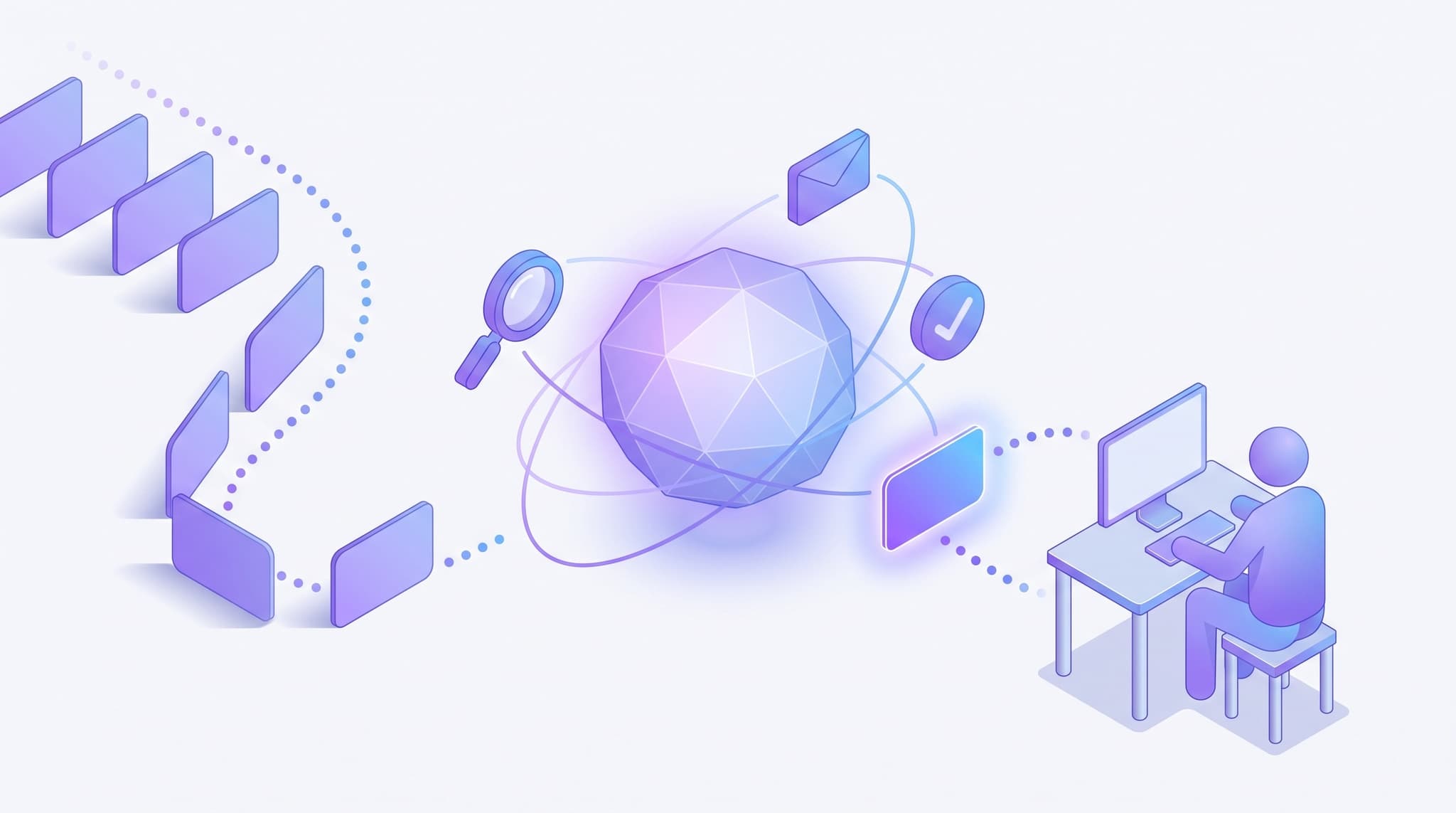
An AI SDR is an artificial-intelligence sales development representative — software that automates the top of the sales funnel: researching leads, sending personalized outreach, answering replies, and qualifying prospects before a human rep steps in. It works every hour of every day, so no lead waits and reps spend their time closing, not chasing.
The role it borrows its name from is real. A human sales development representative (SDR) is the person who works raw leads — reaching out, following up, weeding out the poor fits, and booking qualified prospects for a closer. It's essential work, and it's also repetitive, high-volume, and easy to do inconsistently. That combination is exactly what AI is good at absorbing, which is why the "AI SDR" has become one of the most-searched ideas in sales tech and a natural extension of the AI CRM.
Why the AI SDR idea took off
Sales reps don't actually spend much time selling. Salesforce's State of Sales research found that reps spend less than 30% of their time actually selling — the rest disappears into admin, data entry, prospect research, and internal busywork (Salesforce, State of Sales, 2023). Most of what an SDR does before a real conversation happens is precisely the kind of repetitive, rules-based work that eats those hours.
At the same time, speed has never mattered more. The classic Harvard Business Review study "The Short Life of Online Sales Leads" found that companies contacting a lead within an hour were seven times more likely to have a meaningful, qualifying conversation than those who waited even 60 minutes longer — and 60 times more likely than firms that waited 24 hours or more (Harvard Business Review, 2011). Humans can't watch the inbox at 2 a.m. Software can. An AI SDR closes that gap by responding the instant a lead arrives.
The momentum is now mainstream. According to Salesforce's State of Sales report (2024), 81% of sales teams are already experimenting with or have fully implemented AI in their workflows — and top-of-funnel prospecting is one of the first places it lands.
How does an AI SDR work?
An AI SDR strings together the same steps a human SDR would, but runs them automatically and in seconds. A typical workflow looks like this.
- Ingest and research the lead. A new lead arrives from a form, ad, chat, or import. The AI enriches it with available context — company size, industry, source, and what the lead said or clicked.
- Personalize the first touch. Instead of a generic blast, it drafts outreach tailored to the lead's context and sends it on the right channel — usually email or SMS — within moments of capture.
- Handle the reply. When the lead responds, the AI reads intent, answers common questions, and keeps the conversation moving toward a next step rather than letting it stall.
- Qualify against your criteria. It checks the lead against the rules you define — budget, fit, timing, service area — to separate the sales-ready from the not-yet-ready. This is automated lead qualification running on every lead, not just the ones a human gets to.
- Follow up on a cadence. Most leads don't reply to the first message. The AI runs a persistent, polite follow-up sequence — the part of sales follow-up humans most often drop.
- Hand off or book. When a lead is qualified and interested, the AI books the meeting or hands the lead to a human closer with the full context attached, so the rep starts warm.
The point isn't to remove people from the process. It's to make sure the mechanical, time-sensitive steps happen every time, instantly, so your closers spend their hours on the conversations that actually need a human.
AI SDR vs. human SDR
An AI SDR and a human SDR aren't really competitors — they're good at opposite things. The table below shows where each one wins.
| Human SDR | AI SDR | |
|---|---|---|
| Speed to first touch | Minutes to hours | Seconds, 24/7 |
| Capacity | Fixed — a set number of leads per day | Scales to spikes without new hires |
| Consistency | Varies with mood, workload, and the day | Same process every time |
| Personalization at scale | Deep but slow | Good and instant; less nuanced |
| Complex, high-trust conversations | Strong — reads the room | Weak — misses subtlety and emotion |
| Cost per lead handled | Higher as volume grows | Low and flat once set up |
| Judgment and creativity | The whole point of the role | Limited to its training and rules |
The honest read: an AI SDR is faster, cheaper, and tireless on the repetitive front end, while a human SDR is irreplaceable the moment a deal needs judgment, negotiation, or a relationship. The strongest setups pair them — the AI handles volume and speed, the human handles nuance — which is why "AI SDR vs. human SDR" is usually the wrong question. It's AI SDR plus human closer.
What an AI SDR can and can't do well
Buying into the hype without knowing the edges is how teams get burned. Be clear-eyed about both sides.
| Handles well | Struggles with |
|---|---|
| Instant response to inbound leads | Nuanced, emotional, or high-stakes conversations |
| High-volume, consistent follow-up | Reading between the lines of a hesitant buyer |
| First-pass qualification on clear rules | Judgment calls on ambiguous fit |
| Personalized outreach at scale | Genuine relationship-building and trust |
| Working leads around the clock | Complex negotiation and objection handling |
| Never forgetting a follow-up | Knowing when to break the script |
The pattern is simple: AI SDRs excel at anything repetitive, high-volume, and rules-based, and they falter anywhere real human judgment is the value. Push one past its limits — let it run complex conversations unsupervised — and it can send tone-deaf messages that quietly damage your brand. Keep it on the front end, keep a human on the back end, and the trade works.
AI SDR vs. AI voice agent vs. basic automation
These terms get blurred, so it's worth separating them. Basic sales automation fires fixed actions on triggers — "send email B two days after a form fill." It's rules with no intelligence. An AI voice agent is a phone-specific tool that can answer and place calls, handle spoken questions, and book appointments by voice. An AI SDR is the broadest of the three: it works across channels — email, SMS, chat, and sometimes voice — to research, contact, qualify, and hand off leads.
In practice they overlap. A capable AI agent can act as the voice channel for an AI SDR, taking the call when a lead prefers to talk. And an AI SDR leans on ordinary automation for the deterministic bits. Think of it as a spectrum from dumb-but-reliable (automation) to smart-and-conversational (AI SDR), with the voice agent as one specialized channel along the way.
Do you actually need a dedicated AI SDR?
Here's the part the vendors won't lead with: most small businesses don't need to buy a standalone "AI SDR" product to get its biggest benefits. The high-value pieces — instant lead response, automatic follow-up, and rules-based qualification — are increasingly built into the CRM you already run. If your CRM can reply to a new lead in seconds, chase it on a follow-up cadence, and qualify it against simple rules, you've captured the parts of an AI SDR that move revenue, without a new tool or a bigger headcount.
A dedicated AI SDR platform starts to earn its keep when your inbound volume is high, your outbound motion is real, and a human team genuinely can't keep up with first-touch and follow-up. Below that threshold, layering AI-driven response and follow-up onto your existing stack usually delivers most of the upside at a fraction of the cost and complexity. The goal is the outcome — every lead worked fast and consistently — not owning a product with "AI SDR" on the label.
How to roll out an AI SDR without wrecking your brand
Whether you buy a platform or build the behavior into your CRM, the safe path is the same.
- Start with response and follow-up, not full autonomy. The lowest-risk, highest-return use is instant first-touch and reliable follow-up. Nail that before letting AI run open-ended conversations.
- Write your qualification rules down first. An AI SDR is only as good as the criteria it qualifies against. Define what "sales-ready" means — budget, timing, service area, fit — before you automate the decision.
- Keep a human in the loop early. Review the AI's messages and hand-offs for the first few weeks. You're checking tone and accuracy, not just clicks.
- Set a clean hand-off. Decide exactly when a lead moves from AI to human, and make sure the rep inherits the full conversation. A qualified lead dumped without context is a wasted hand-off.
- Measure the right things. Track speed-to-first-touch, follow-up completion, and qualified-lead rate — not vanity volume. Pair this with AI lead scoring so the leads reaching your closers are ranked by real likelihood to convert.
Common AI SDR mistakes
Automating conversations you don't understand yet. If you can't articulate your qualification criteria, the AI will guess — badly. Map the process by hand first.
Letting it run unsupervised on day one. Unwatched AI outreach at scale can send a lot of off-brand messages fast. Supervise early, loosen the reins as trust builds.
Treating it as a headcount replacement. An AI SDR multiplies a good sales motion; it doesn't create one. If your follow-up and qualification are broken, automating them just breaks them faster.
Ignoring the hand-off. The moment a lead is qualified is the moment a human should get a warm, context-rich hand-off. Skip that and the AI's speed advantage evaporates at the finish line.
Buying a platform you'll underuse. For many small teams, the AI SDR capabilities already in their CRM cover the highest-value work. Don't buy complexity you won't grow into.
The bottom line
An AI SDR is the automation of top-of-funnel sales work — research, outreach, follow-up, and first-pass qualification — running instantly and around the clock so no lead waits and your people spend their time on conversations that need a human. Its strength is speed and consistency on repetitive work; its weakness is anything requiring real judgment or trust. The best setups pair an AI front end with a human closer.
For most small businesses, the smartest move isn't buying a standalone AI SDR — it's turning on instant response, automatic follow-up, and rules-based qualification inside the CRM you already have. To see how that fits into the bigger picture of AI-driven selling, start with the definitive guide to AI CRMs.
Frequently asked questions
What is an AI SDR?
What is the difference between an AI SDR and a human SDR?
Do AI SDRs actually work?
Is an AI SDR the same as an AI voice agent?
Do small businesses need an AI SDR?
About the author
Easyly Team
The Easyly Team writes about AI, CRM, and running a small service business.