Sales Funnel Stages: The Complete Guide for Small Businesses (2026)
The sales funnel has four stages that move a prospect from first discovering you to buying. What each stage means, funnel vs. pipeline, and how to move leads through without losing them.
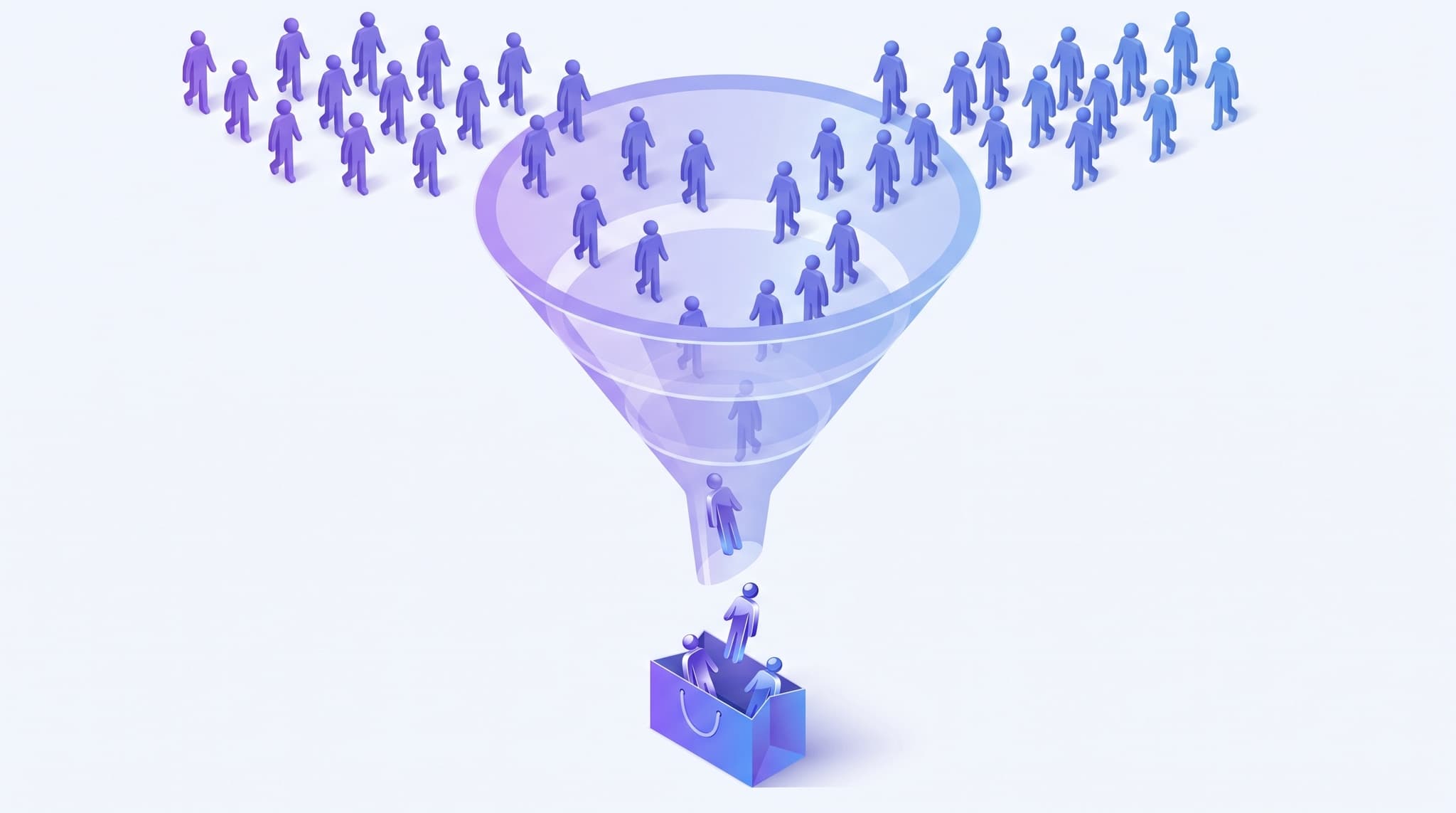
What are the sales funnel stages?
The four sales funnel stages — awareness, interest, decision, and action — map a prospect's path from first discovering your business to becoming a customer. Each stage narrows the pool: many people become aware, fewer show interest, fewer still decide, and only a subset buy. Knowing the stages is how you find where leads leak out — and fix it.
The funnel is a model, not a machine. Real prospects skip steps, loop back, and go quiet for weeks. But the shape holds everywhere: a wide top full of strangers who just found you, narrowing to a slim bottom of people ready to pay. Understanding each stage tells you two things that run a small business's sales — what the prospect needs from you right now, and where you're losing the most people. This guide breaks down all four stages, shows how the funnel differs from a sales pipeline, and covers how to move leads through each stage without letting them slip away. It's one part of a complete lead management process.
The 4 stages of a sales funnel
Marketers have used variations of this model for over a century — the classic "AIDA" formula (Attention, Interest, Desire, Action) dates to the 1890s. The modern version most small businesses use has four stages. Here's what each one means, what the prospect is doing, and your job at that point.
| Stage | Funnel layer | What the prospect is doing | Your job | Typical conversion to next stage |
|---|---|---|---|---|
| 1. Awareness | Top (TOFU) | Just discovered you exist; has a problem, not a shortlist | Get found, make a strong first impression | 2–5% of visitors become leads |
| 2. Interest | Middle (MOFU) | Actively researching options, comparing approaches | Educate, build trust, capture contact info | 10–30% of leads engage seriously |
| 3. Decision | Bottom (BOFU) | Narrowing to a shortlist, wants a quote or demo | Make the case, remove friction, quote fast | 20–40% of qualified leads buy |
| 4. Action | Bottom (BOFU) | Ready to buy; needs a clear, easy path | Make purchasing effortless, then deliver | — |
The exact percentages vary wildly by industry, price point, and lead source — treat them as illustrative, not benchmarks. What matters is the pattern: the funnel narrows sharply at every step, so a small improvement in one stage's conversion compounds through everything below it.
Stage 1 — Awareness
This is the top of the funnel, where someone with a problem first encounters your business — through a Google search, a referral, a social post, or an ad. They're not thinking about you yet; they're thinking about their problem. A homeowner with a leaking roof isn't looking for "Acme Roofing," they're searching "roof leak repair near me."
Your only job here is to get found and make a credible first impression. That's why content that answers real questions — like the article you're reading now — is a funnel's foundation. This shift matters more than ever: according to Gartner's B2B buying journey research, B2B buyers spend just 17% of their total purchase journey meeting with potential suppliers, and that time is split across every vendor they're considering. The overwhelming majority of the decision happens while the buyer is researching on their own — before they ever talk to you. If you're not visible and helpful during that independent research, you're not even in the funnel. For the demand-generation side of this stage, see our guide to lead generation for small business.
Stage 2 — Interest
Now the prospect knows you exist and is actively evaluating. They're reading your pages, comparing you to two or three alternatives, and starting to form an opinion. In funnel shorthand this is the "middle" (MOFU), and it's where most small businesses lose people quietly — not with a "no," but with silence.
Your job at the interest stage is to earn trust and capture a way to keep talking: an email, a phone number, a booked call. Give before you ask — a useful guide, a transparent price range, a genuinely helpful answer — and the exchange feels fair. Once you have contact details, the interest stage is where a structured lead nurturing sequence does its work, staying useful over days or weeks until the prospect is ready to decide. This is also the moment to figure out who's actually a fit, which is the job of lead qualification: not everyone who shows interest should advance, and sorting early saves you from quoting people who were never going to buy.
Stage 3 — Decision
The prospect has a shortlist and is ready to choose. They want specifics: a quote, a proposal, a demo, real pricing. This is the bottom of the funnel (BOFU), and the deals here are the most valuable in your whole business — they're minutes from becoming revenue or walking to a competitor.
Two things win the decision stage: making your case clearly and removing friction. Answer the objection they're actually stuck on — usually price, timing, or trust — head-on rather than hoping it goes away. And respond fast. The classic study from Harvard Business Review (2011), which audited 2,241 companies, found that firms contacting a prospect within an hour were nearly seven times more likely to have a meaningful qualifying conversation than those that waited even 60 minutes longer. At the decision stage, a same-day quote often beats a better price that arrives two days late. For the mechanics of responding quickly, see our guide to lead response time.
Stage 4 — Action
The prospect has decided to buy. It sounds like the easy part, but plenty of ready-to-buy customers stall here on pure friction: a confusing checkout, a contract that needs three signatures, an invoice that takes two days to arrive. Every extra step is a chance for second thoughts.
Your job is to make purchasing effortless — a clear next step, an easy way to pay or sign, and immediate confirmation that they made a good choice. Then deliver well, because the action stage isn't really the end. A happy customer feeds the top of your funnel through referrals and repeat business, which is why many teams add a fifth retention stage for onboarding, follow-through, and reviews. Winning a customer costs far more than keeping one, so the funnel that loops back on itself is the one that compounds.
Sales funnel vs. sales pipeline
These two get used interchangeably, and confusing them leads to building the wrong thing. They describe the same journey from opposite sides.
| Sales funnel | Sales pipeline | |
|---|---|---|
| What it is | A marketing model of how prospects convert on average | An operational tool listing your actual live deals |
| Perspective | The buyer's journey | The seller's process |
| Measures | Volume and conversion rates between stages | Where each specific deal is right now |
| Answers | "Where are we losing people, and how many?" | "What do I need to do on the Smith deal today?" |
| Owned by | Marketing + sales leadership | The reps working deals |
| Covered in depth | This guide | How to build a sales pipeline |
The simplest way to hold the difference: the funnel is the pattern; the pipeline is the list. The funnel tells you that 30% of quotes close, so you need more quotes to hit your number. The pipeline tells you which five quotes are open this week and which one has gone quiet. You need both — the funnel to see the system, the pipeline to work the deals. A good CRM shows you the pipeline directly and lets you calculate the funnel from it.
How to move leads through each stage
A funnel doesn't move prospects on its own; you do, by matching your action to the stage. The most common small-business mistake is treating every lead the same — pitching hard to someone in awareness, or sending generic "just checking in" notes to someone ready to buy.
- Awareness → Interest: Get discovered with content that answers the questions your buyers actually search, then offer a low-commitment next step (a guide, a price range, a quick consult). The goal is a captured contact, not a sale.
- Interest → Decision: Nurture with genuinely useful touches and qualify as you go. Give proof — case studies, reviews, transparent pricing — and identify the real fit before investing time in a quote.
- Decision → Action: Respond fast, quote clearly, and answer the specific objection blocking the deal. Speed and clarity win here more than discounts do.
- Action → Retention: Make buying and onboarding effortless, then follow through so the customer becomes a referral source and feeds your funnel's top again.
The reason funnels leak is almost never a lack of leads — it's inconsistent follow-through in the middle. That's a time problem, and it's a big one: according to Salesforce's State of Sales research (2023), sales reps spend under 30% of their time actually selling, with the rest lost to admin, data entry, and manual outreach. The fix isn't working harder; it's automating the routine stage-to-stage touches so no lead sits forgotten in the middle. Tie each stage transition to an automatic action in your CRM — a new lead triggers a first email, a quote triggers a follow-up sequence, a purchase triggers onboarding — and the funnel keeps moving whether or not anyone remembers to push it.
How to measure your sales funnel
You can't improve a funnel you don't measure. The core metric is the conversion rate between each stage — what share of prospects make it to the next step. Track these, and the stage with the steepest drop-off tells you exactly where to focus.
| Metric | What it measures | Why it matters |
|---|---|---|
| Stage conversion rate | % moving from one stage to the next | Pinpoints your single biggest leak |
| Overall lead-to-customer rate | % of all leads that eventually buy | The headline number for funnel health |
| Time in stage | How long deals sit before advancing | Long dwell time signals a stuck stage |
| Cost per lead / per customer | Marketing spend ÷ leads or customers | Tells you which channels actually pay off |
| Average deal value | Revenue per closed customer | Shows whether the funnel attracts the right buyers |
Start with just the stage conversion rates. If 1,000 people hit your site, 40 become leads, 3 request a quote, and 1 buys, you don't have a top-of-funnel problem — you have a middle-of-funnel problem. A 4% visitor-to-lead rate is healthy, and a third of quotes closing is solid, but fewer than 8% of leads ever ask for a quote: the sharpest drop is interest-to-decision. Fixing the weakest transition returns more than pouring new leads into a funnel that leaks in the same spot. Measure first, then fix the biggest leak, then measure again.
Common sales funnel mistakes
Treating the funnel as linear. Real buyers loop back, go quiet, and skip stages. Build for re-entry — a lead who went cold in the decision stage six months ago can re-enter at interest tomorrow.
Pouring in more leads to fix a middle-funnel leak. If your problem is a 3% interest-to-decision rate, doubling your ad budget just doubles the number of people you lose in the middle. Fix the leak before you scale the volume.
One message for every stage. Pitching a price to someone still in awareness, or sending "just checking in" to someone ready to buy, both misfire. Match the message to the stage.
No follow-up in the middle. The interest-to-decision gap is where most deals die — not from a "no," but from silence. A nurture sequence that runs automatically is the single highest-leverage fix for most small-business funnels.
Measuring only the top and bottom. Leads in and sales out tells you that you have a problem, not where it is. The stage conversion rates in between are where the answer lives.
Ignoring the post-purchase stage. Winning a customer and never following up wastes your cheapest source of new funnel volume: the people who already trust you.
The bottom line
The sales funnel's four stages — awareness, interest, decision, and action — aren't just a diagram; they're a diagnostic. Each stage tells you what a prospect needs from you right now, and the conversion rate between stages tells you exactly where your business is losing money. Most small businesses don't have a lead-volume problem. They have a middle-of-funnel problem: leads that arrive, show interest, and then quietly disappear because nobody followed up consistently.
Fixing that is less about clever tactics than about a system that never drops a lead — one that captures every prospect at awareness, nurtures them through interest, responds fast at the decision point, and makes buying effortless at action. Map your own funnel, measure the drop-off between each stage, and automate the transitions so the leads you already paid for actually make it to the bottom. Pair this with a working sales pipeline and a complete lead management process, and the funnel stops leaking where it always did.
Frequently asked questions
What are the stages of a sales funnel?
What is the difference between a sales funnel and a sales pipeline?
How many stages should a sales funnel have?
What are TOFU, MOFU, and BOFU?
How do you measure a sales funnel?
About the author
Easyly Team
The Easyly Team writes about AI, CRM, and running a small service business.